

Journal · Guide
A real showroom tour, and what it's for.
Published November 2, 2024 · Updated July 19, 2026
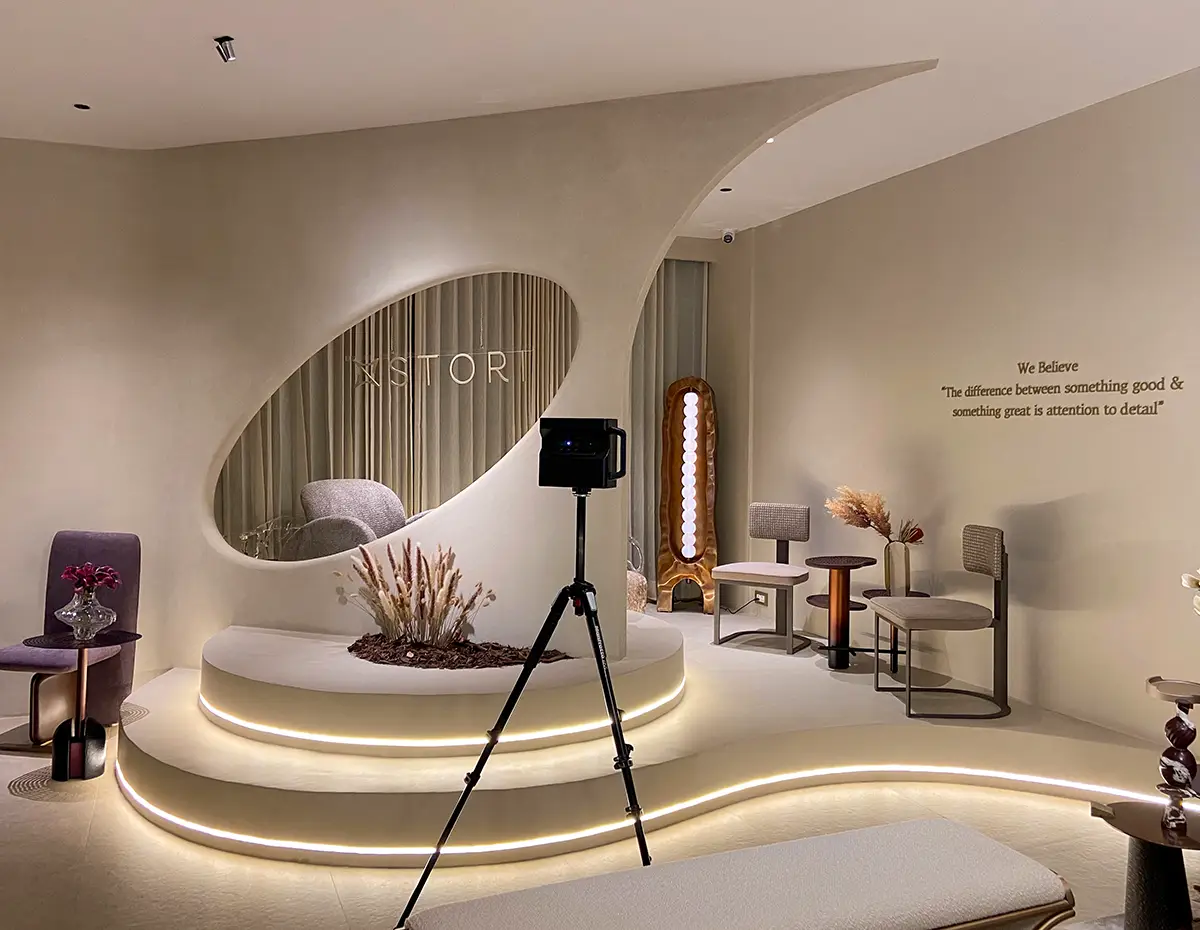
India's retail sector is real and substantial: valued at roughly $1.06 trillion in 2024, projected by IBEF and Deloitte-FICCI to approach $1.93 trillion by 2030. A showroom competing in that market is competing against online convenience directly, and a walkable 3D tour is one of the more useful tools for making a physical space worth the trip.
A real example: Stori Design, New Delhi
Click to explore this space
A premium physical showroom, walkable in full before ever visiting in person. Someone evaluating the space or the inventory can get a genuine sense of scale and layout remotely, which shortens the gap between initial interest and an actual visit.
What a retail-focused tour is actually good for
Mattertags placed directly on key products can carry descriptions, images, and a link straight to the matching page on the retailer's own site. Someone browsing the 3D space can go from "what is this" to "here's the product page" without leaving the tour. Capturing extra detail around higher-value inventory specifically, closer, more deliberate coverage than the rest of the space gets, also lets someone closely inspect texture and detail in a way a flat product photo can't match.
Embedding the tour on the retailer's own site, and linking it from their Google Business Profile, connects the online presence back to the physical space directly. The tour becomes the bridge between someone's first search and an actual store visit.
Where this could go further
To separate this clearly: some of what follows is a real capability of this kind of spatial data, not something confirmed as delivered on the Stori project specifically. Mattertags could, in principle, be used internally for inventory or merchandising checks across multiple locations, and conversion tracking (tagged product links, monitored through Google Tag Manager) could attribute real revenue to the tour rather than treating it as a purely visual asset. Both are genuine, achievable uses of this technology, just not something to claim as already built out here without saying so plainly.
Before you ask
Worth knowing.
How is a product tagged inside a showroom tour?
Mattertags are placed directly on specific products, holding a description, images, and a direct link to that product's page on the retailer's own site.
What's the real difference between a 3D tour and a 360° photo for retail?
A 360° photo shows one fixed viewpoint stitched together. A 3D tour captures real dimensional data, so a shopper can walk between areas and actually judge scale and layout, not just look around from one spot.
Can this data be used for internal inventory checks?
The underlying spatial data supports that kind of use, though that's a capability of the technology, not something confirmed as a delivered service on every project.
Related
Where this connects.
Start a project
Tell us about the space, and we'll tell you what it'll take.
Most replies come within a day. Most enquiries start with a short email about the space.
Email info@adostrophe.com