

Journal · Field notes
Five elements, one tour.
Published May 15, 2022 · Updated July 19, 2026
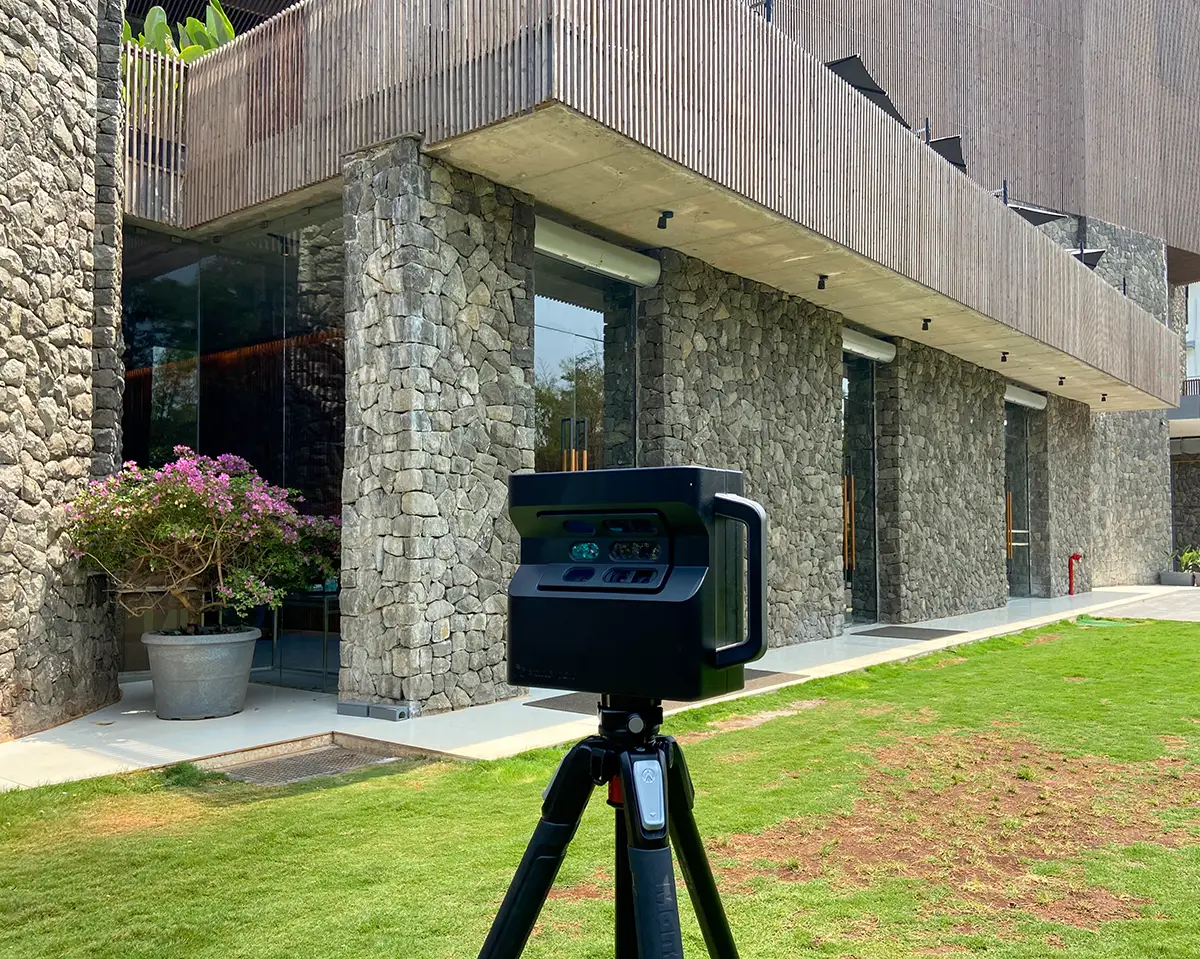
The Radisson Resort & Spa, Lonavala, is built around a real architectural idea: a design rooted in Maratha fort heritage, organized around the five classical elements, Pancha Mahabhuta. A standard photo gallery can't really carry that story. A walkable, structured 3D tour can.
Structuring the tour around the five elements
Earth (Prithvi): the resort's design pays tribute to the rugged forts of the region. The Deccan Basalt walls were excavated directly from the site itself, and the tour lets someone inspect that texture and the scale of the property's 21-meter gabion retaining wall up close.
Water (Jal): the tour walks through Hirkani, the resort's restaurant, past the well at the center of the buffet, a nod to the Hirkani folk story well known in Maratha history. From there it moves to the Kund pool, with its black floor designed specifically to absorb solar heat.
Fire (Agni): the spaces used for the resort's traditional Tutari and Mashal fire ceremonies are captured in full, with Mattertags carrying video of the actual ceremonies directly inside the tour.
Air (Vayu): the open corridors of the Sinhgad and Vijaygad wings, designed to channel wind off the Sahyadri hills, come through in a way a flat photo can't convey. The tour captures how open the space actually is.
Space (Aakash): the resort's event venues, including the 4,260 sq ft divisible Raj Bhavan and the adjacent Royal Bastion, are where the tour does its most direct commercial work. MICE planners can walk the space and measure it themselves, remotely.
What this is genuinely good for
For a destination wedding specifically, this matters more than most property types: an entire family, including relatives abroad, can walk the banquet halls, lawns, and rooms together remotely, and arrive at a decision with real confidence rather than guesswork from a brochure.
One clarification on scope: the same data could, in principle, support remote staff training on brand standards, vendor coordination for events, or facilities planning. These are real capabilities of this kind of spatial data, not something formally delivered as a separate service on this property specifically.
Before you ask
Worth knowing.
How does a 3D tour help with a destination wedding specifically?
It lets an entire family, including relatives abroad, conduct a virtual site inspection together: banquet halls, lawns, and accommodation, giving them the confidence to book a high-value event remotely rather than relying on photos alone.
What does the Pancha Mahabhuta theming actually mean for the tour?
The resort's design is organized around the five classical elements (Earth, Water, Fire, Air, and Space), and the tour follows that same structure, connecting real architectural and cultural details, like the Hirkani folklore and the site-excavated basalt, to the spaces themselves.
How was a large, active resort scanned without disrupting guests?
In sections, scheduled around occupancy: rooms captured between checkout and the next check-in, common areas during off-peak hours.
Related
Where this connects.
Start a project
Tell us about the space, and we'll tell you what it'll take.
Most replies come within a day. Most enquiries start with a short email about the space.
Email info@adostrophe.com