

Journal · Then and now
Google Ads, then and now.
Published October 27, 2017 · Updated July 19, 2026
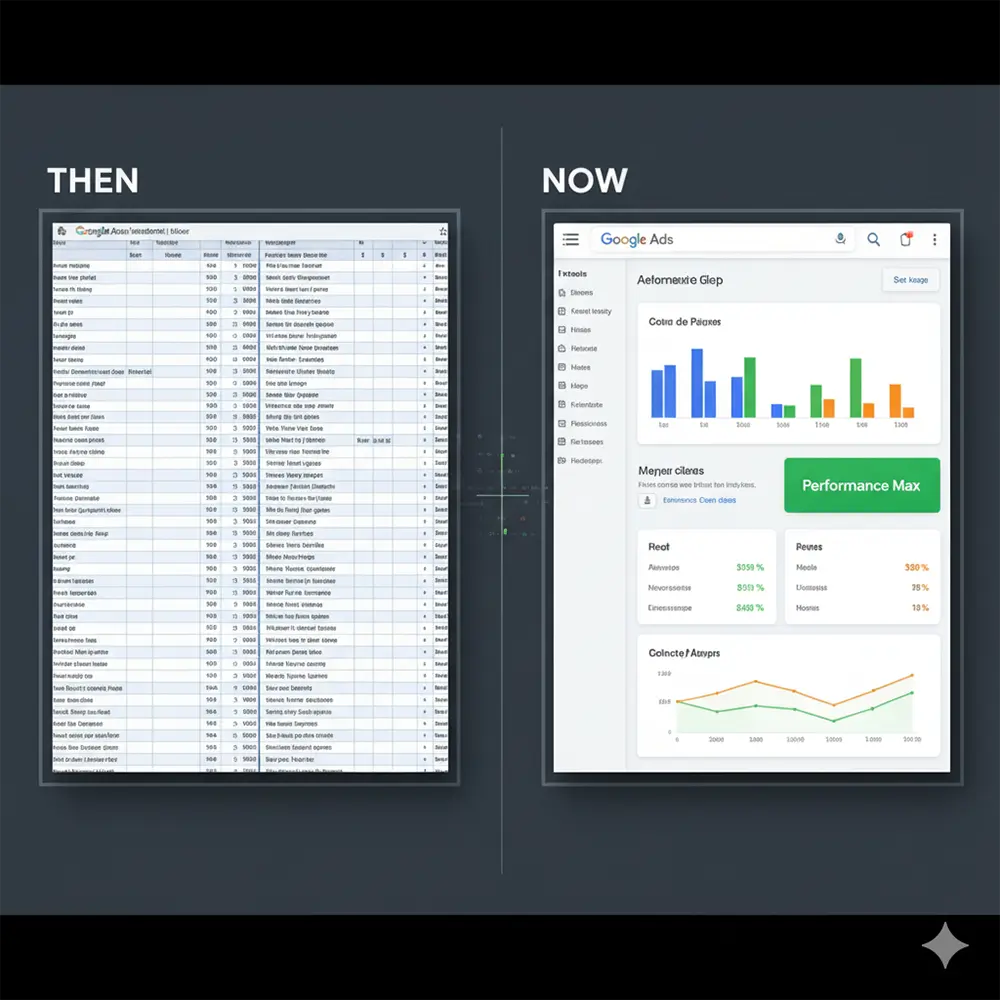
Search marketing has been the day job since 2004, and this post has been updated periodically since it first went up in 2017. Rather than pretend nothing's changed, here's how different the actual day-to-day work is now, and where that history still matters.
How it used to work
Building a keyword list meant manually concatenating terms in Excel: every product, every modifier, every match type, expanded out into hundreds or thousands of rows before anything went near the platform. Ad copy was written character-by-character against a hard limit, tested two variants at a time, and everything got uploaded and adjusted through Google Ads Editor, offline, before syncing changes live. Bid adjustments were manual, negative keywords were added by hand after combing through search term reports, and nothing moved without someone actually deciding it should.
How it works now
Most of that manual structure has been absorbed into automation. Performance Max runs a single campaign across Search, YouTube, and Display, letting the algorithm decide where budget goes based on the goal and the assets provided. AI Max, which came out of beta this year, does something similar for Search specifically, expanding beyond exact keywords to match on intent, and starting this September, Google is auto-upgrading older Dynamic Search Ads and broad-match setups into it whether an advertiser asks for it or not. Performance Max is only now getting real A/B testing through asset experiments, years after advertisers asked for the ability to actually see what's working inside the "black box." Ad copy generation increasingly leans on AI image and text tools built directly into the platform. Call-only ads are being phased out entirely by early 2027, folded into responsive search ads instead.
What hasn't actually changed
The old discipline of thematic keyword grouping, making sure an ad group's copy genuinely matches what someone's searching for, still determines whether an automated campaign performs or quietly burns money. The algorithm optimizes toward whatever signals it's given; it doesn't know if those signals are good. That's the real risk with letting automation run unsupervised: a Performance Max or AI Max campaign can spend steadily, report activity, and still convert badly, because nobody's checking whether the underlying structure actually makes sense.
If that's happening, with budget going out consistently without conversions to show for it, that's exactly the kind of thing a manual audit catches quickly. Worth a conversation rather than letting it run.
Before you ask
Worth knowing.
Is manual campaign management still relevant in 2026?
The manual setup work has mostly been replaced by automation, but the underlying discipline, making sure targeting and creative assets actually match search intent, still determines whether that automation performs well or wastes budget.
What is AI Max, and is it mandatory?
A set of AI features layered onto Search campaigns, expanding beyond exact keyword matching. It's not mandatory today, but Google is auto-upgrading older Dynamic Search Ads and broad-match campaigns into it starting September 2026.
Why would automated campaigns need a manual audit?
Automation optimizes toward whatever signals it's given, but doesn't know if those signals are actually good. An account can spend steadily and still convert badly if the underlying structure is off. That's what an audit is for.
Start a project
Tell us about the space, and we'll tell you what it'll take.
Most replies come within a day. Most enquiries start with a short email about the space.
Email info@adostrophe.com